












The RJ45 SFP (Copper SFP Module) is an Ethernet module that uses a standard SFP/SFP+ package and outputs via an RJ45 interface. It is used to implement copper Ethernet connections in optical module slots.
1G RJ45 SFP: Compliant with IEEE 802.3ab (1000BASE-T) standard
10G RJ45 SFP+: Compliant with IEEE 802.3an (10GBASE-T) standard, some models support NBASE-T multi-rate.
RJ45 SFP modules are widely used in network devices such as switches, routers, and firewalls, and are an important solution for achieving mixed deployment of optical and electrical ports.
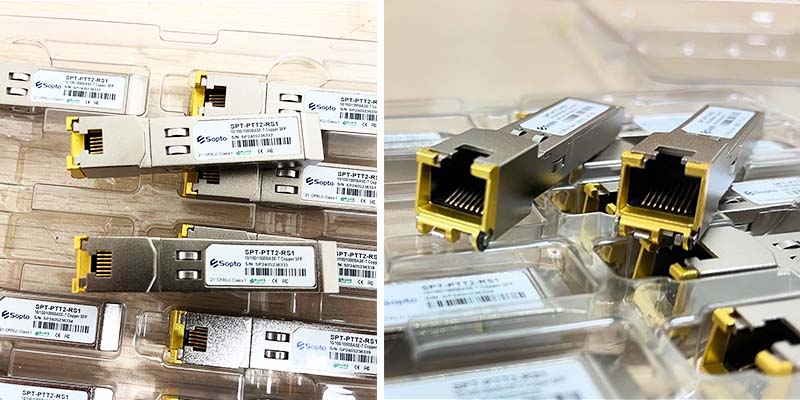
Key advantages of 1G vs 10G Copper RJ45 SFP
High compatibility: Expands the SFP optical port to an RJ45 electrical port.
The RJ45 SFP module adopts a standardized interface design and can be directly inserted into the SFP/SFP+ slots of mainstream brand switches to achieve RJ45 electrical port output, significantly improving the flexibility of port use.
Low-cost deployment: Reusing existing copper cabling networks
By using RJ45 SFP, the existing Ethernet cabling can be reused, avoiding the need to lay new fiber optic cables.
Rate | RJ45 SFP type | Recommended cables | Maximum distance |
1G | 1000BASE-T SFP | Cat5e / Cat6 | 100 m |
10G | 10GBASE-T SFP+ | Cat6A | 30m |
Flexible networking: Supports smooth network upgrades
During the network evolution from 1G to 10G, RJ45 SFP modules can serve as a transitional solution, allowing for equipment upgrades first and cabling upgrades later, thus reducing the overall transformation risk.
Multi-rate support: Adapted to NBASE-T network environment
Most 10G RJ45 SFP+ modules support multi-rate auto-negotiation.
10G / 5G / 2.5G / 1G / 100M
It is especially suitable for new terminal devices such as Wi-Fi 6 / Wi-Fi 6E APs and 2.5G / 5G servers.
Operations-friendly: Reduces deployment and maintenance difficulty
The RJ45 interface is more intuitive in terms of testing, maintenance, and troubleshooting, making it suitable for large-scale deployment and long-term operation and maintenance by enterprise IT teams.
Typical application scenarios of RJ45 SFP
10G server access in data centers
In a ToR/EoR architecture, 10G RJ45 SFP+ is commonly used for short-distance (≤30 m) server access, connecting SFP+ switches to 10GBASE-T network cards.
Enterprise Park Network and Office Network
1G RJ45 SFP switches are widely used in enterprise access and aggregation layer networks to enable the connection between SFP architecture switches and RJ45 terminal devices.
Wi-Fi 6 / Wi-Fi 6E AP access
With wireless AP interface speeds increasing to 2.5G / 5G / 10G, the 10G Copper RJ45 SFP+, which supports multiple speeds, has become an ideal choice.
Industrial Ethernet and Security Monitoring
In industrial automation and video surveillance systems, RJ45 SFP modules enable stable connections between optical port aggregation devices and front-end RJ45 devices.
RJ45 SFP Selection and Deployment Recommendations
Focus on power consumption and heat dissipation capabilities
1G RJ45 SFP: Power consumption is typically < 1.5W
10G RJ45 SFP+: Power consumption approximately 2.5–3.5W
Before deployment, it is necessary to confirm the switch's support for high-power Copper SFPs.
Ensure device compatibility
Different brands of switches have varying compatibility with RJ45 SFP modules. It is recommended to choose a Copper SFP module that supports multi-brand compatibility or customized coding.
Match the appropriate network cable type
In 10G scenarios, it is recommended to use Cat6A network cables to ensure stable transmission performance and maximum link distance.
Why choose a 1G/10G RJ45 SFP?
As an important bridge connecting optical devices and copper cable networks, 1G and 10G Copper RJ45 SFP modules have significant advantages in network upgrades, hybrid networking, and cost control.
With proper selection and standardized deployment, RJ45 SFPs will continue to play a key role in data centers, enterprise networks, and next-generation wireless networks.
Frequently Asked Questions
What is an RJ45 SFP (Copper SFP module)?
An RJ45 SFP (also known as a Copper SFP) is a module that uses a standard SFP/SFP+ package and outputs Ethernet signals through an RJ45 interface. It is used to implement copper cable connections on switches or network devices that only provide SFP optical ports.
What is the difference between an RJ45 SFP and a fiber optic SFP?
RJ45 SFP uses twisted-pair cable (Cat5e / Cat6 / Cat6A) for transmission and is suitable for short distances and environments with existing copper cabling; Fiber SFP uses fiber optic cable for transmission and is suitable for long distances, high bandwidth, and high port density data centers.
What is the maximum transmission distance of a 1G RJ45 SFP?
The 1G RJ45 SFP conforms to the 1000BASE-T standard and can achieve a maximum transmission distance of 100 meters when using Cat5e or Cat6 network cables.
What is the maximum transmission distance of a 10G RJ45 SFP+?
The transmission distance of 10G RJ45 SFP+ depends on the cable type: Cat6: typically up to 30 meters ; Cat6A: up to 100 meters (recommended).
Can a regular network cable be used with a 10G RJ45 SFP+?
In some short-distance scenarios, 10G RJ45 SFP+ can work with Cat6 cables, but to ensure stability and long-term reliability, it is strongly recommended to use Cat6A cables.
Does the 10G RJ45 SFP+ support 2.5G/5G?
Most 10G RJ45 SFP+ modules that support NBASE-T can automatically negotiate 10G/5G/2.5G/1G/100M, making them ideal for Wi-Fi 6/Wi-Fi 6E access and multi-rate server environments.
Does the RJ45 SFP support PoE?
RJ45 SFP modules do not provide PoE power supply functionality. PoE power supply capability depends on the switch's port design, not the SFP module itself.
Does the RJ45 SFP consume a lot of power?
Compared to optical modules, RJ45 SFPs have relatively higher power consumption : 1G RJ45 SFP: typically below 1.5W ; 10G RJ45 SFP+: approximately 2.5–3.5W.
Before high-density deployment, the power consumption budget and heat dissipation capacity of the switch ports should be confirmed.
How to choose between RJ45 SFP and DAC cables?
RJ45 SFP: Suitable for scenarios where there is existing copper cabling and flexible cabling is required.
DAC straight-through cable: Suitable for short-distance, high-port-density connections within a server rack.
RJ45 SFP is more versatile in network upgrades or hybrid networking.
Are there any compatibility issues with RJ45 SFP?
Some switches have high compatibility requirements for RJ45 SFP. It is recommended to choose a supplier that supports multi-brand compatibility testing or customized coding to improve the success rate of the project.
Typical Selection Recommendations
Server 10G access (≤30 Mbps): 10G RJ45 SFP+ + Cat6A
Enterprise campus network access layer: 1G RJ45 SFP
Wi-Fi 6 / Wi-Fi 6E AP access: Supports multiple speeds of 10G RJ45 SFP+
Network upgrade transition phase: RJ45 SFP + existing copper cabling
If you are looking for a stable and highly compatible 1G /10G Copper RJ45 SFP module, we can provide:
● Multi-brand switch compatibility testing
● 1G / 10G / Multi-rate RJ45 SFP products
● OEM/ODM and Coding Customization Services
● Project-level selection and technical support
Please contact us for product specifications, test reports, or project quotations . Email: [email protected] WhatsApp: https://wa.me/+8618688759008
Tags: RJ45 SFP, Copper SFP, 1G RJ45 SFP, 10G RJ45 SFP+, 10GBASE-T SFP, Copper SFP Module, RJ45 SFP