











High-speed interconnect cables are the core infrastructure of modern data centers, server rooms and cloud computing systems. When deploying 25G, 100G, 400G network connections, DAC and AOC are the two most popular interconnection solutions. Many network architects and IT engineers are confused about which one fits their project. Below is a complete introduction to DAC and AOC cables, including working principles, pros & cons, comparison table and selection advice.
What is DAC Cable?
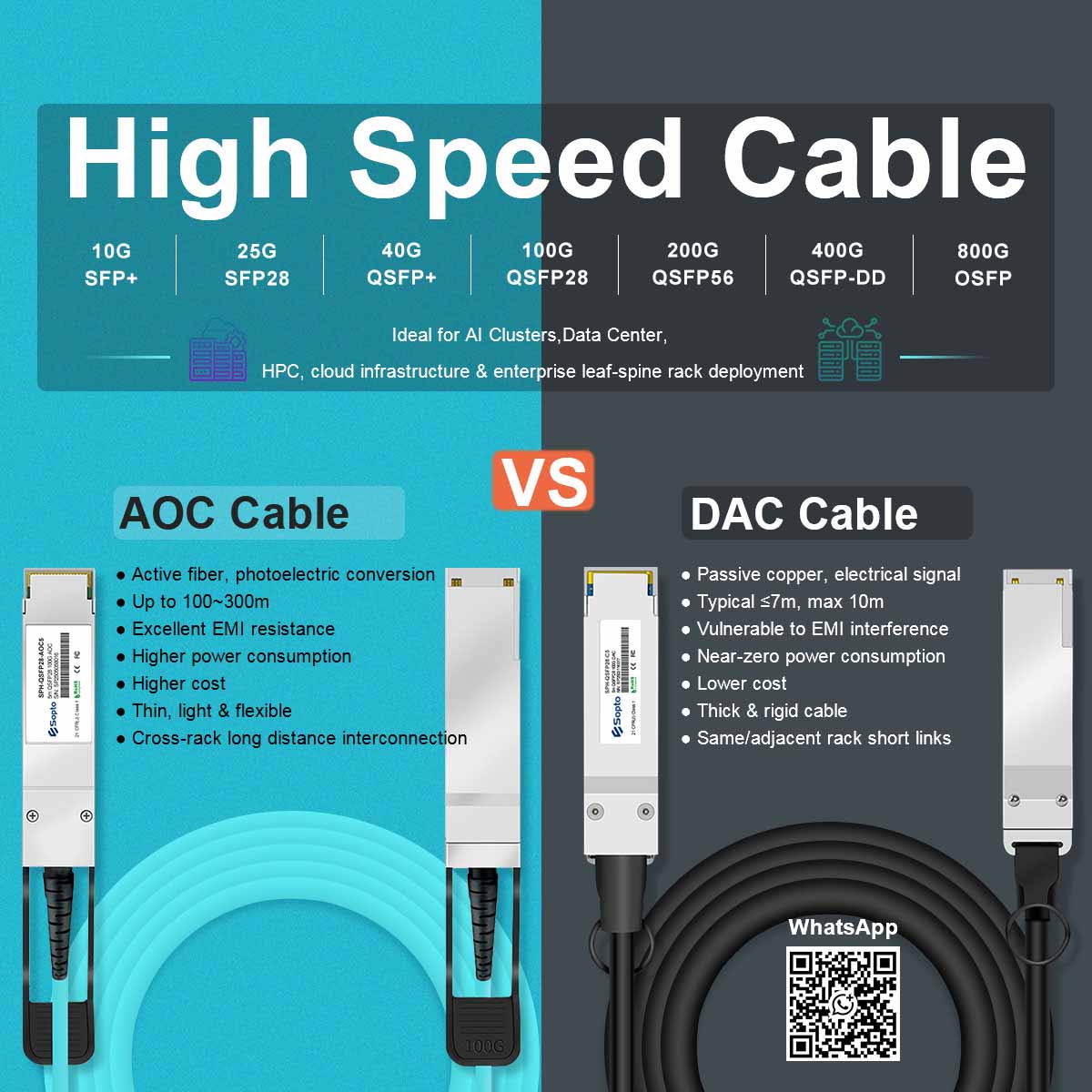
DAC is short for Direct Attach Copper Cable, also known as direct attach twinax copper cable. DAC is a passive assembly. Both ends are pre-fitted with transceiver connectors, and the middle transmission medium is twinax copper wire. There is no active optical chip or signal conversion component inside the cable. When working, the electrical signal passes directly through the copper cable between two network devices without signal conversion.
Advantages
1. Passive design, no power consumption during operation
2. Low unit cost, economical for short-distance deployment
3. Simple structure, high reliability, low failure rate
4. Plug and play, easy installation and maintenance
Limitations
1. Copper material is heavy, not friendly for dense cabling
2. Susceptible to electromagnetic interference
3. Transmission distance is limited, normally up to 7–10 meters
4. Poor bending performance compared with optical fiber
Application Scenarios: Short-distance connection within the same cabinet, rack-to-rack links in adjacent cabinets, top of rack switch connections, cost-sensitive small server rooms.
What is AOC Cable?
AOC stands for Active Optical Cable. It is an active integrated cable assembly. AOC has built-in optical-electrical conversion chips at both ends. When transmitting data, the electrical signal from the switch is converted into an optical signal for transmission through internal optical fiber, then converted back to electrical signal at the receiving end. The whole signal conversion process needs tiny power supply.
Advantages
1. Optical fiber medium, ultra-light weight, easy for dense cable management
2. Excellent anti-electromagnetic interference capability, stable signal in complex industrial and cabinet environments
3. Long transmission distance, available from 10m up to 100m
4. Good bending property, flexible cabling layout
Limitations
1. Active chips inside, slightly higher power consumption
2. Higher price than DAC cable
3. The active components have service life limits
Application Scenarios: Cross-rack long-distance interconnection, large data center cabling, environments with strong electromagnetic interference, projects requiring neat lightweight cable layout.
How to Choose Between DAC and AOC Cable
Choose DAC: Your connection distance is within 10 meters, budget is limited, short rack internal connection.
Choose AOC: Cabling distance exceeds 10 meters, dense cable layout, heavy electromagnetic interference environment.
Our DAC and AOC high-speed cables support 25G/100G/400G mainstream rate options, compatible with most mainstream brand switches. We can provide customized length and labeling services for your data center projects. Contact our technical team to get product datasheet and quotation.
Tags : DAC cable, AOC cable, direct attach copper cable, active optical cable, high speed cable
— END —