










An optical time domain reflectometer (OTDR) is a core testing instrument for fiber optic installation, cable acceptance, and troubleshooting. Many engineering contractor and maintenance teams focus only on the nominal kilometer measurement range during procurement, neglecting crucial parameters such as dynamic range, dead zone, and wavelength. This can lead to inaccurate test result, missed near-end connector, and even damage to active optical module. This article cover application scenarios, core specification, a selection comparison table, and common misconception, aiming to help you choose the right OTDR for FTTH, PON, data center, metropolitan area network, and long-haul fiber optic network.
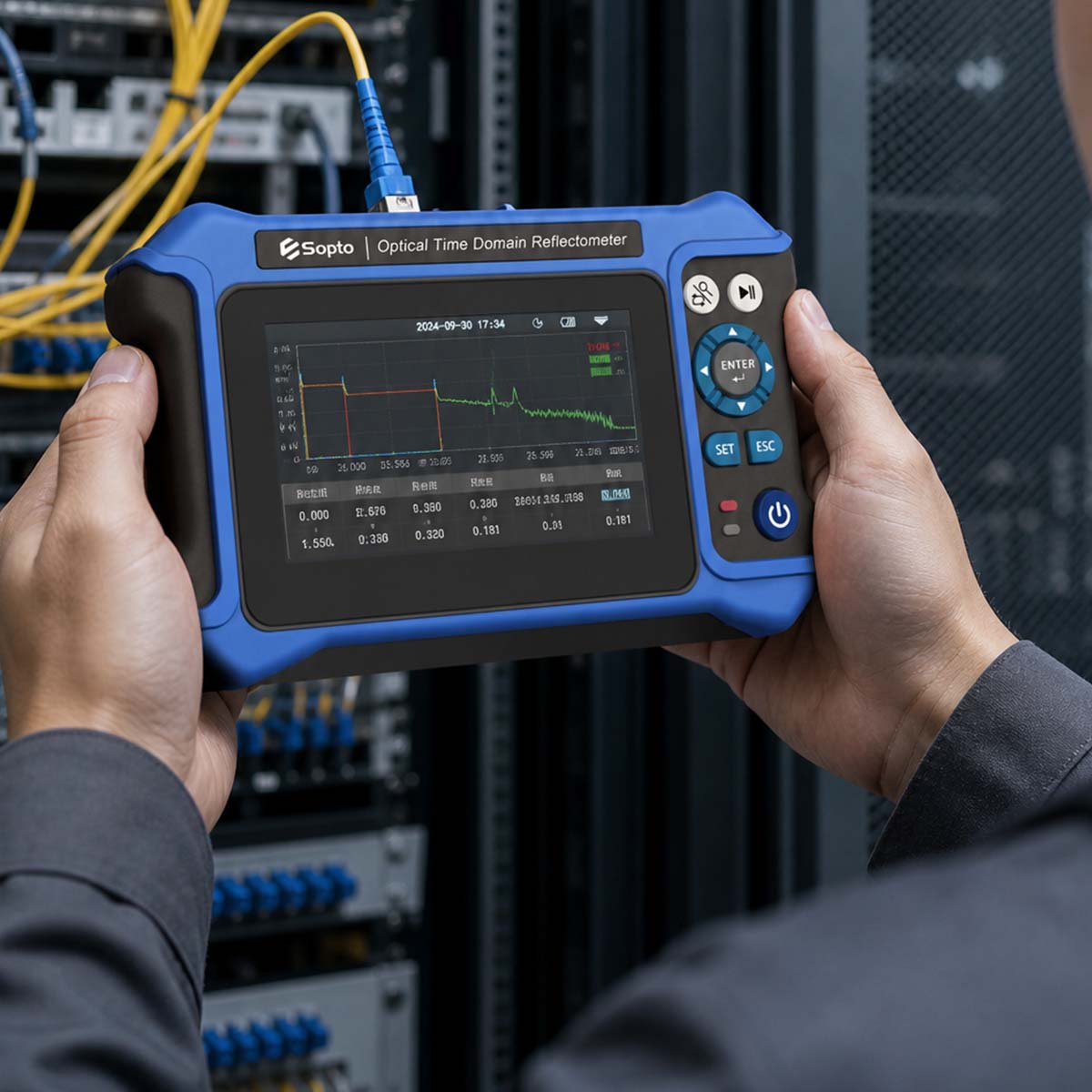
Stable fiber optic network rely on reliable link detection. Optical Time Domain Reflectometer (OTDR) support single-ended testing of fiber length, splice loss, connector reflection, breakpoint location, and bending loss, and are standard equipment for 5G, FTTH, structured cabling, and backbone fiber maintenance. However, OTDRs come in a wide variety of models with significant price differences and inconsistent parameter marking standard. Choosing the wrong OTDR can increase procurement cost, introduce potential acceptance risk, and delay fault repair.
Identify the application scenario.
Parameter comparison are performed after the test path has been defined. Different application scenarios have different requirement for OTDR
● FTTH/PON Home Access and MDU Deployment Short link, dense connector, and high splitter losse. Low dead zone model are preferred. Troubleshooting during operation require the use of an OTDR with filtering capabilitie; standard 1310/1550nm OTDR cannot be used with charged optical fiber.
● Data Center and Structured Multimode Cabling High-density patch cord and flange require small dead zones. Common wavelengths: 850nm and 1300nm for multimode fiber.
● Metropolitan area and access fiber optic cable : Optical fiber tens of kilometer long. Both test distance and loss measurement are important, requiring sufficient dynamic range.
● Long-distance trunk cable Long-distance links suffer from high total loss. High dynamic range, distance accuracy, and sampling resolution are crucial.
Important Note: Standard OTDRs and in-service OTDRs are not interchangeable. When performing real-time PON testing, a 1625nm/1650nm filtered OTDR must be used to avoid service bands and protect active optical modules.
Core OTDR Technical Specification
1. Test wavelength
Wavelength determines the compatible fiber type and the purpose of the test
● Standard single-mode 1310nm & 1550nm: Used for structural acceptance and weld loss detection. 1310nm is insensitive to micro-bending loss, making it ideal for weld quality assessment. 1550nm is sensitive to macro-bending loss, making it easier to detect flattening or bending defect.
● PON in-service online testing: 1625nm/1650nm, which are maintenance wavelength with built-in filter, are the first choice for troubleshooting PONs with service.
● Multimode fiber (OM3/OM4/OM5): 850nm and 1300nm, widely used in data centers and campus LAN.
● Connector type: APC termination is widely used in PON network. It is recommended to use an APC OTDR port. Return loss measurement on APC connectors using UPC ports are inaccurate and may damage the termination face.
2. Dynamic range (dB) – Used to determine the total permissible link loss at a reference test distance.
Dynamic range refers to the difference between the backscattering intensity and the noise floor. A higher dynamic range can tolerate higher total link loss.
Reference calculation basis: G.652D single-mode fiber, attenuation is approximately 0.35dB/km at 1310nm wavelength and approximately 0.20dB/km at 1550nm wavelength. The following values are the theoretical maximum transmission distance of pure optical fiber (without splitters or additional connector losses). In actual deployment, a loss margin of 5~8dB should be reserved to compensate for losses from fusion splice, flange, and splitter.
- 26~30dB: Practical application range less than 10km, suitable for FTTH, short link and patch cord testing.
- 32~38dB: Practical application range is 10~80km, suitable for PON access and metropolitan fiber optic connection.
real-world applications of long-distance trunk optical cables exceeding 80 KM.
Note: Manufacturer specify dynamic range for different pulse widths and averaging time. Always test parameters under identical conditions. Theoretical kilometers are for reference only. Splitter, connector, and bend introduce additional losses and significantly reduce the actual measurable distance.
3. Dead Zone: Event Dead Zone (EDZ) and Attenuation Dead Zone (ADZ) – Critical for short link
Dead zone is an often overlooked parameter. For connector-dense FTTH and data center links, an excessively large dead zone can mask faults in near-end flanges and connectors.
● Event Dead Zone (EDZ): The minimum distance after a strong reflection point from which the next reflected event can be detected. The smaller the distance, the better. For Fiber to the Home (FTTH) networks, an EDZ ≤ 1 meter is recommended.
● Attenuation Dead Zone (ADZ): The minimum distance at which connector loss can be accurately measured after a strong reflection event. ADZ is generally greater than EDZ; high-end models can achieve an ADZ of around 2 meters.
In short: For long-haul trunk lines, the requirements for blind spots are relatively lenient. However, for data centers and short links with high-density fusion splicing, low blind spots are the primary consideration.
4. Pulse width
Pulse width is used to balance resolution and test distance. Most modern optical time domain reflectometers (OTDR) support both automatic and manual pulse selection.
● Narrow pulse (10ns, 30ns): small dead time, high resolution, suitable for short links with dense connector; disadvantages: low signal energy, limited test distance.
● Wide pulse (1μs, 10μs): Strong signal energy, suitable for long-distance testing; Disadvantages: Larger dead zone and weaker detail resolution.
5. Distance accuracy, refractive index and sampling resolution
Typical distance accuracy: ±(1 meter + 0.001% × measurement distance). The standard refractive index of G.652D single-mode fiber is approximately 1.468. Incorrect refractive index settings will result in significant distance deviations.
More sampling points and smaller sampling intervals can generate richer curve details, enabling accurate stitching and minor loss analysis.
6. Scope
The range refers to the maximum distance displayed on the horizontal axis, not the actual measurable distance defined by the dynamic range. Setting the OTDR range to 1.5 to 2 times the actual fiber length can reduce ghosting events and simplify waveform interpretation.
Additional features and hardware to improve on-site efficiency
In addition to core optical specifications, practical built-in functions should also be considered:
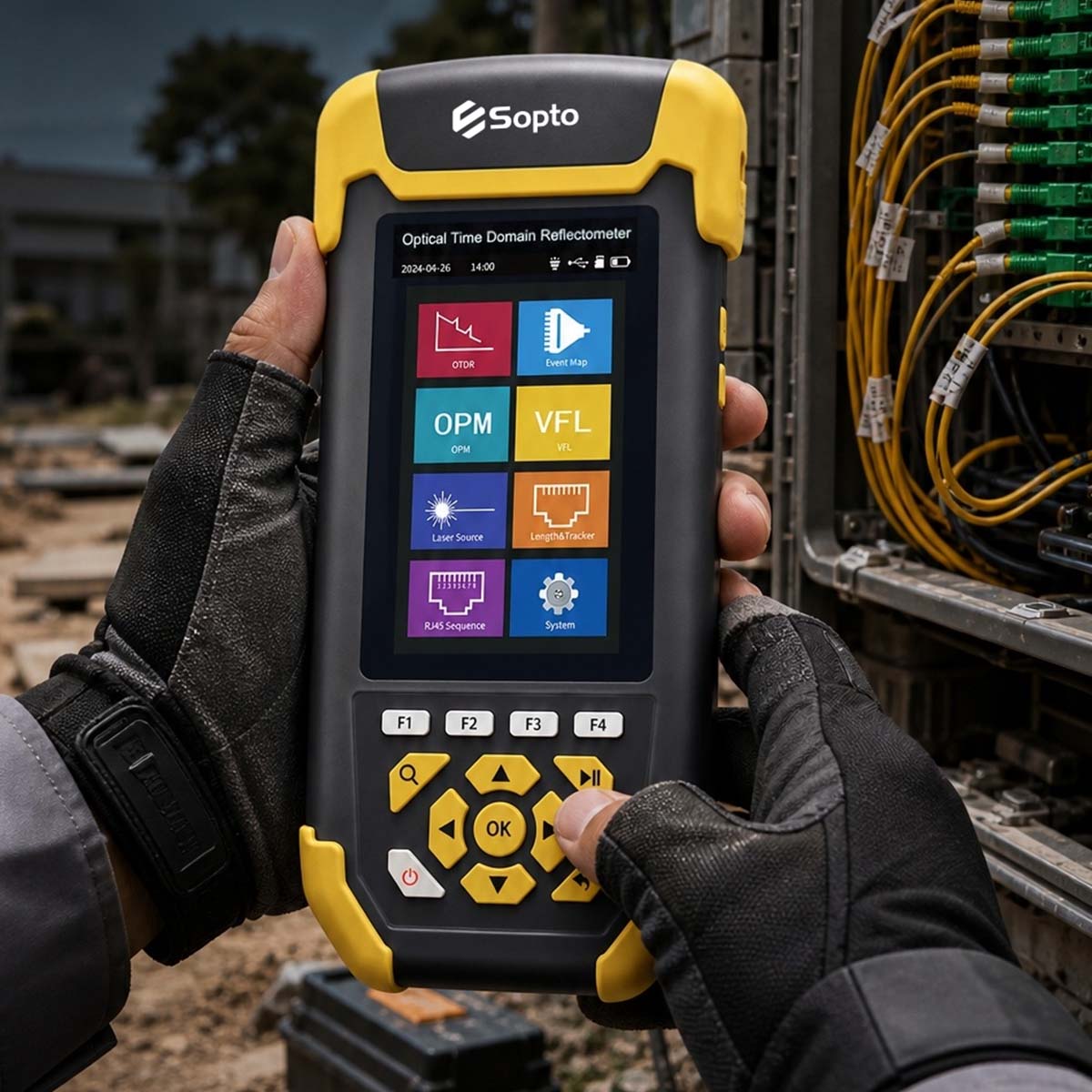
● Integrated Module: VFL visual fault locator, optical power meter, light source, and end-face inspection device. The integrated design reduces the number of tools required in the field.
● Automatically perform event analysis, event graphs, and test report export to quickly complete acceptance documentation preparation.
● Wi-Fi and data storage for track uploading and remote viewing.
● Battery life, IP rating, screen and weight: Handheld lightweight OTDRs have a long runtime and are the preferred choice for field maintenance.
● Return loss and reflectivity testing: a necessary condition for acceptance testing of PON and APC links.
Common OTDR purchasing error
● Only check the nominal kilometer range: The data provided by the manufacturer is the ideal theoretical value for pure fiber. Splitters and connectors cause losses, so OTDRs usually cannot reach the nominal distance.
● Using trunk -class OTDRs for short data center links: High dynamic range is wasted, and large blind spots can hide near-end connectors.
● Testing charged optical fibers using a standard OTDR: There is a risk of service interruption and damage to optical modules.
● Confusing EDZ and ADZ: A smaller event blind zone does not guarantee accurate loss measurement.
● Connector interface mismatch: The UPC port on the APC connector will produce unreliable readings and may damage the end face.
The right OTDR isn't necessarily the highest specification model. The key is matching the application scenario, allowing for loss margins, and balancing dead zones and dynamic range. For FTTH and dense rack links, choose an OTDR with low dead zones; for long-distance trunk links, choose an OTDR with high dynamic range; for operational PON networks, choose an in-service OTDR with filtering capabilities. Before purchasing, confirm the fiber type, total link length, whether the test is in-service, and the connector type. Filter by wavelength, dynamic range, and dead zone to select a cost-effective and reliable fiber optic test instrument.
If you have OTDR procurement need, please contact us to obtain customized parameter solution and demo sample. Email: [email protected] 丨WhatsApp: https://wa.me/+8613751094939
Tags : OTDR, optical time domain reflectometer , fiber tester, FTTH OTDR
— END —