













With the rapid development of artificial intelligence (AI), cloud computing, and hyperscale data centers, modern data center network architecture is evolving rapidly. AI workload require higher bandwidth, lower latency, and greater scalability. As a result, 400G SR4 optical module and 800G SR8 optical module are becoming key technologies in next-generation data center infrastructure.
In recent years, more operators and system integrator have been deploying high-speed optical networking solution. Based on industry deployment experience, optical communication provider—including Sopto Technology—have observed a significant increase in demand for high-density and high-bandwidth optical connectivity in AI-driven data center.
This article explore the technology trend, deployment strategies, and real-world applications of high-speed optical modules in AI data center network.
AI Is Driving the Transition Toward 800G Data Center Network
Compared with traditional internet services, AI training clusters generate massive east–west traffic. Large language model training, GPU clusters, and high-performance data processing all require ultra-fast communication between servers.
As a result, the data center network upgrade path is evolving as follows:
100G → 400G → 800G → 1.6T
Today, most hyperscale data centers have already deployed 400G network architectures, while 800G networks are rapidly emerging as a key direction for AI-focused data centers.
Several factors are driving this transformation:
● Rapid expansion of AI training clusters
● Increased data exchange between GPUs
● Continuous expansion of hyperscale cloud infrastructure
● Development of high-density switching platforms
● Growing demand for energy-efficient data center networks
In this environment, high-speed optical modules play a crucial role in enabling scalable network performance.
400G SR4 Optical Modules in Modern Data Center
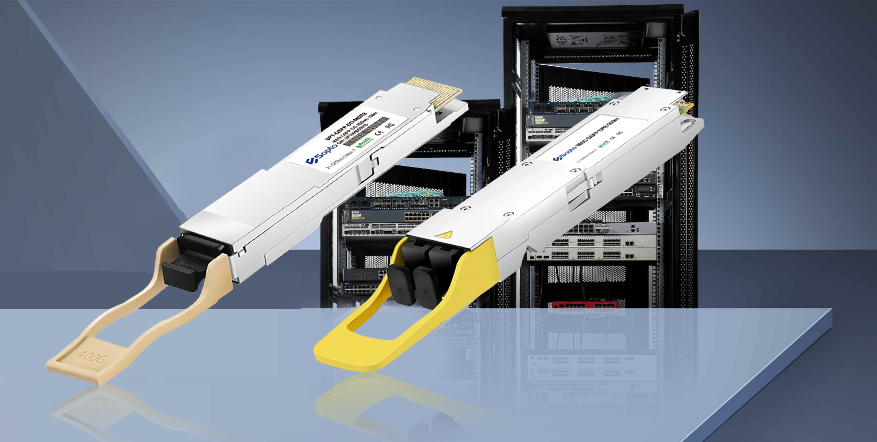
The 400G SR4 optical module is currently one of the most widely deployed solutions for short-reach high-speed interconnects inside data centers.
Key Features of 400G SR4 Optical Modules
● 400Gbps high-speed transmission
● Parallel multimode fiber architecture
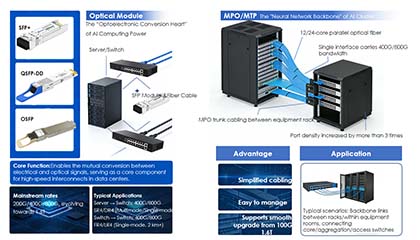
● MPO/MTP high-density interface
● Designed for short-reach data center connectivity
● Low latency and high reliability
Typical Deployment Scenarios
In practical deployments, 400G SR4 optical modules are commonly used for:
● Server-to-switch connectivity
● GPU compute node interconnection
● Top-of-Rack (ToR) switching architectures
● High-density rack environments
In many AI data center projects, optical networking providers such as Sopto Technology often combine these modules with high-density MPO cabling systems to help customers design scalable network architectures that support future upgrade.
800G SR8 Optical Modules: The Next Step for AI Infrastructure
As AI clusters continue to scale, the adoption of 800G optical modules is accelerating. Among them, 800G SR8 optical modules are considered a key technology for next-generation AI data center interconnects.
Advantages of 800G SR8 Optical Modules
● 800Gbps ultra-high bandwidth
● Significant increase in network capacity
● Lower cost per transmitted bit
● Higher switch port density
● Better scalability for future AI clusters
Where 800G SR8 Is Deployed
In AI data center networks, 800G SR8 optical modules are typically deployed in:
● Spine layer switching networks
● Data center core layers
● AI training cluster networks
● Hyperscale cloud data centers
Today, many newly built data centers are being designed with 800G-ready architectures from the beginning.
High-Speed Optical Modules Require High-Density Fiber Infrastructure
In both 400G and 800G deployments, fiber cabling infrastructure plays a critical role. The most widely adopted approach is MPO/MTP high-density fiber systems.
Key benefits include:
● Support for large-scale port connectivity
● Faster data center deployment
● Easier network expansion
● Improved space efficiency
In real-world projects, many data centers deploy integrated optical connectivity solutions that include:
● High-speed optical modules
● MPO trunk cables
● MPO fiber patch cords
● Data center fiber distribution systems
Solution providers such as Sopto Technology often help customers design complete optical network architectures tailored to AI data center environments.
Planning the Migration from 400G to 800G Data Center
Many data centers are adopting phased upgrade strategies to reduce investment risk and improve network efficiency.
A typical migration roadmap includes:
Phase 1 – Deploy 400G network architecture
Phase 2 – Optimize fiber cabling infrastructure
Phase 3 – Upgrade core switching platforms
Phase 4 – Introduce 800G connectivity
By planning high-density fiber systems early, organizations can simplify future network upgrades.
Future Trends in AI Data Center Optical Network
As AI technology continues to evolve, the data center optical networking industry is also advancing rapidly. Several trends are expected to shape the future:
● Large-scale deployment of 800G optical networks
● Development of 1.6T optical modules
● Emergence of AI-optimized network architectures
● Adoption of silicon photonics technologies
● Increasing switching capacity in hyperscale data centers
High-speed optical interconnects will become a core component of global AI infrastructure.
AI is transforming the architecture of modern data centers, and 400G SR4 and 800G SR8 optical modules are becoming essential technologies for enabling high-speed connectivity.
While 400G remains the mainstream deployment today, 800G is rapidly emerging as the next standard for AI data centers. Planning high-speed optical infrastructure and high-density fiber systems in advance can help organizations meet future network demands more effectively.
For companies building AI data centers or upgrading network infrastructure, working with experienced optical connectivity solution providers can significantly improve deployment efficiency and long-term network performance.
Tags : 400G SR4 optical module, 800G SR8 optical module, AI data center network, data center optical solution, high-speed optical transceiver
— END —