











As modern telecommunications networks and data centers continue to demand higher fiber density and greater cable capacity, 200μm optical fiber has become an increasingly popular alternative to the traditional 250μm fiber. While both fiber types offer similar optical performance, their differences in coating diameter significantly impact cable design, fiber density, and installation requirements.
Understanding 200μm and 250μm Fiber
Both 200μm and 250μm fibers typically use the same glass structure:
● Core diameter: 9μm (single-mode) or 50/62.5μm (multimode)
● Cladding diameter: 125μm
● UV coating diameter: 200μm or 250μm
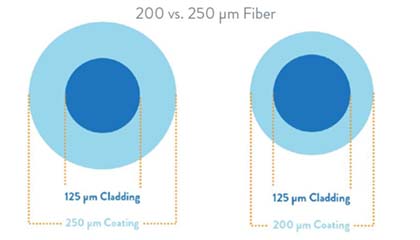
The primary difference lies in the thickness of the protective coating applied around the glass fiber.
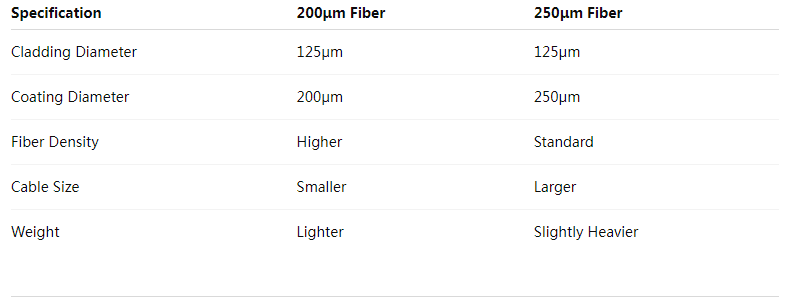
Higher Fiber Density with 200μm Fiber
One of the biggest advantages of 200μm fiber is its ability to support higher fiber counts within the same cable diameter.
Because each fiber occupies less space, cable manufacturers can:
● Increase fiber count without increasing cable size
● Reduce overall cable diameter
● Improve duct utilization
● Lower transportation and installation costs
For example, a cable designed with 200μm fibers can accommodate significantly more fibers than a comparable cable using 250μm fibers.
This makes 200μm fiber particularly attractive for:
● High-count outdoor cables
● Data center backbone networks
● Metro and long-haul networks
● 5G transport infrastructure
● Fiber-rich campus environments
Mechanical Performance Comparison
The thicker coating of 250μm fiber provides additional mechanical protection.
Advantages of 250μm Fiber
● Better resistance to handling damage
● Higher tolerance during installation
● Well-established industry standard
● Easier field operations
Advantages of 200μm Fiber
● Reduced cable size
● Improved packing density
● Lower cable weight
● Increased network scalability
Modern 200μm fibers are engineered to maintain excellent reliability and mechanical performance, making them suitable for demanding network environments.
Splicing and Installation Considerations
250μm Fiber
250μm fiber remains the most widely used standard in telecommunications networks. Most fiber stripping tools, splice protectors, and installation procedures are optimized for this size.
200μm Fiber
200μm fiber requires:
● Compatible stripping tools
● Proper fiber management accessories
● Technicians familiar with high-density fiber handling
However, today's fusion splicing equipment fully supports both 200μm and 250μm fibers, making deployment straightforward for experienced installers.
Optical Performance
From a transmission perspective, there is little difference between 200μm and 250μm fibers.
Both can be manufactured according to industry standards such as:
● ITU-T G.652.D
● ITU-T G.657.A1
● ITU-T G.657.A2
Typical attenuation values remain similar:

As a result, the choice between 200μm and 250μm fiber is generally driven by cable design requirements rather than optical performance.
Typical Applications
250μm Fiber Applications
● FTTH networks
● Access networks
● Distribution cables
● Standard telecommunications infrastructure
200μm Fiber Applications
● High-density optical cables
● Hyperscale data centers
● Cloud computing facilities
● Metro backbone networks
● Long-haul transmission systems
● 5G transport networks
Both 200μm and 250μm optical fibers deliver excellent transmission performance. The key difference lies in fiber density and cable design flexibility.
For traditional access networks and general-purpose deployments, 250μm fiber remains the industry standard due to its ease of handling and robust protection. However, for high-density applications where maximizing fiber count and minimizing cable size are critical, 200μm fiber offers significant advantages.
As network operators continue to expand bandwidth capacity and optimize infrastructure utilization, 200μm fiber is becoming an increasingly important solution for next-generation optical networks and data center cabling systems.
Tags : 200μm optical fiber, 250μm optical fiber, FTTH fiber, G.652.D fiber, G.657 fiber, optical network solutions, fiber optic infrastructure
— END —