












10G SFP+ vs 10G BIDI SFP+: Which Module Belongs in Your Link?
Every 10G fiber link needs a transmitter at one end and a receiver at the other. The question is how much fiber you are willing to spend to make that happen. A standard 10G SFP+ spends two strands. A 10G BIDI SFP+ spends one. Everything else — cost, port density, upgrade headroom, spare-part logic — follows from that single difference.
This guide compares the two module families on reach, fiber count, connector type and deployment risk, so you can pick the right one for a switch-to-switch link, an FTTx backhaul or a campus backbone without over-building.
What a standard 10G SFP+ actually gives you
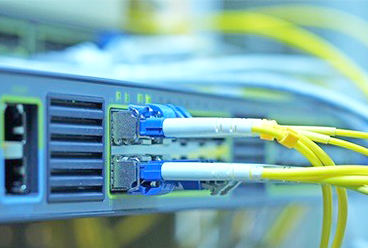
A 10G SFP+ is a hot-swappable, MSA-compliant pluggable that delivers 10 Gbps over a duplex LC interface. Transmit and receive run on two separate strands of the same fiber cable: one strand carries your TX traffic, the other carries the far end's TX traffic back.
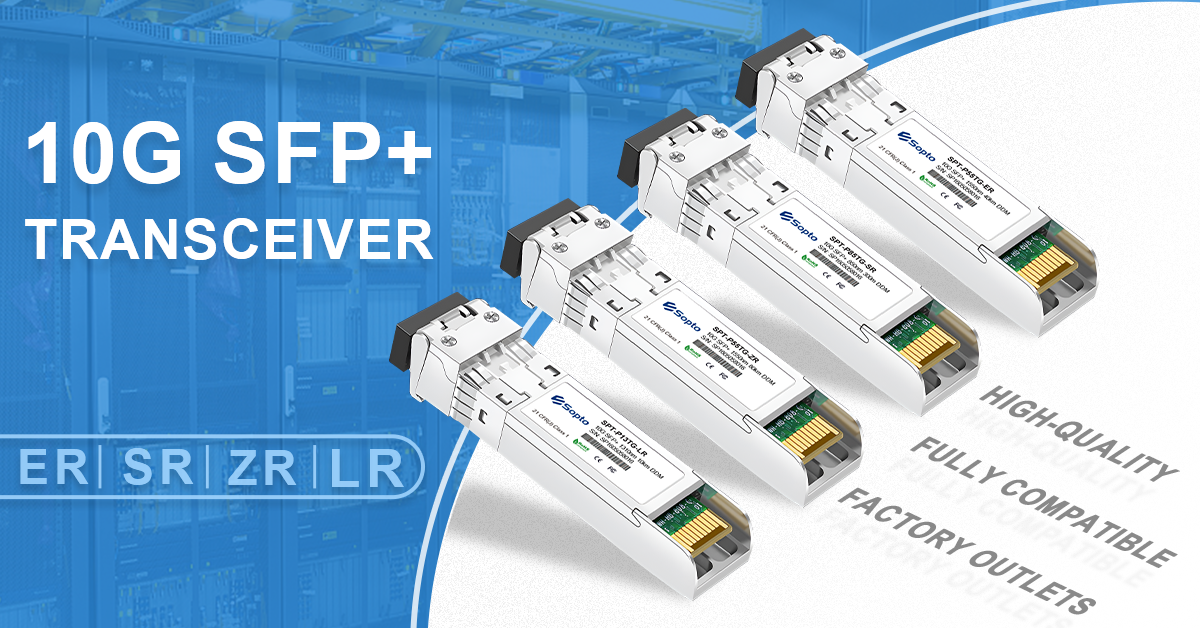
The family covers four distance classes that are still the backbone of most 10G deployments:
| Module | Wavelength | Fiber | Reach |
|---|---|---|---|
| 10GBASE-SR | 850 nm | OM3 / OM4 multimode | 300 m / 400 m |
| 10GBASE-LR | 1310 nm | SMF 9/125 µm | 10 km |
| 10GBASE-ER | 1550 nm | SMF 9/125 µm | 40 km |
| 10GBASE-ZR | 1550 nm | SMF 9/125 µm | 80 km |
Two things matter here. First, SR is the cheapest 10G optic on the market and works on multimode, which makes it the default for in-room and in-row data center links. Second, LR to ZR are all duplex — each link permanently consumes two strands, two patch cords and two adapter ports on the panel.
On a fully populated 24-port switch, that is 48 strands for 24 links. On a 48-port switch, it is 96.
What a 10G BIDI SFP+ changes
A 10G BIDI SFP+ (also written BiDi, BX, or "single fiber bidirectional") puts both directions on one strand by using two different wavelengths. One end transmits at 1270 nm and receives at 1330 nm; the far end does the exact opposite. The two signals travel in opposite directions through the same glass without colliding, and a wavelength-selective filter inside the module separates them at each receiver.
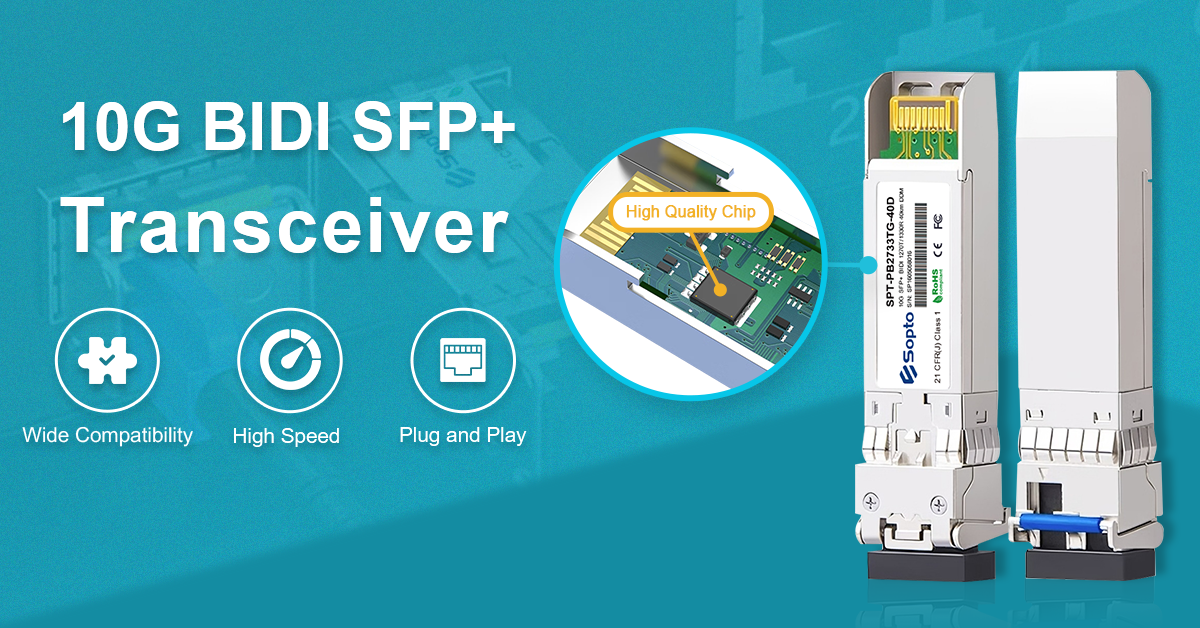
The connector is a single LC (simplex), not a duplex LC. That single change is where the savings come from.
Standard 10G BIDI variants:
| Module | TX / RX Pair | Fiber | Reach |
|---|---|---|---|
| 10GBASE-BX10 | 1270 / 1330 nm | SMF 9/125 µm | 10 km |
| 10GBASE-BX20 | 1270 / 1330 nm | SMF 9/125 µm | 20 km |
| 10GBASE-BX40 | 1270 / 1330 nm | SMF 9/125 µm | 40 km |
| 10GBASE-BX80 | 1490 / 1550 nm | SMF 9/125 µm | 80 km |
The 80 km pair moves to 1490/1550 nm because 1270/1330 nm cannot hold the link budget that far. If you are chaining a 40 km BiDi link into an 80 km one, the wavelengths will not match and the link will not come up.
10G SFP+ vs 10G BIDI SFP+
| Criterion | 10G SFP+ (dual fiber) | 10G BIDI SFP+ (single fiber) |
|---|---|---|
| Strands per link | 2 | 1 |
| Connector | LC duplex | LC simplex |
| Strands for 24 links | 48 | 24 |
| Wavelengths | SR 850 / LR 1310 / ER-ZR 1550 | 1270+1330 or 1490+1550 |
| Pairing rule | Any two like modules | Must pair A-end with B-end |
| Multimode support | Yes (SR, low cost) | Rarely; SMF is the norm |
| Fiber / patch cord cost | Baseline | Roughly halved |
| Panel & adapter pressure | Baseline | Halved |
| Optic price | Lowest for SR | Slightly higher than LR |
| Best fit | Data center rows, MMF, 40/100G migration | Constrained fiber, FTTx, long haul |
Where a 10G BIDI SFP+ pays for itself
1. You are short on strands, not on money. Leased dark fiber, aerial routes, duct-constrained metro rings and older buildings with a fixed strand count are the classic BiDi case. Doubling capacity on the same glass is often cheaper than pulling new cable, especially when trenching, permits or wayleave fees are involved.
2. Patch panel and adapter density is the real bottleneck. Halving strand count halves adapters, patch cords and cable management. In a dense 1U panel, that is the difference between a link that fits and one that does not.
3. FTTx and MDU backhaul. A single-strand 10G link from an OLT aggregation site to a remote cabinet is exactly what BiDi was designed for. It also keeps the strand budget free for PON wavelengths further down the line.
4. You want to reserve strands for a WDM upgrade. Every strand you save today is a channel you can light later with CWDM or DWDM optics, without re-cabling.
5. Long-reach backhaul at 40 and 80 km. BX40 and BX80 cover metro and regional spans with one strand, which is often the only economically viable option on rented fiber.
Where dual fiber 10G SFP+ still wins
● Short multimode runs inside a data center.
SR optics are the lowest-cost 10G part available, and OM3/OM4 is already installed. There is no fiber shortage to solve.
● You need maximum spares flexibility.
Any duplex SFP+ mates with any other of the same reach. BiDi requires a matched opposite part on the shelf — a real logistics cost for field teams.
● You are heading to 40G or 100G.
Those links use MPO parallel optics and breakout cassettes; duplex LC infrastructure is what the migration plan assumes.
● Mixed-vendor environments with no coding control.
Coding and firmware behavior on BiDi pairs is less forgiving than on plain LR.
● Very short links where the fiber is effectively free.
If strands are abundant, the BiDi premium buys you nothing.
FAQ
● Can I connect a 10G BIDI SFP+ to a duplex 10G SFP+?
No. One side expects two strands and two wavelengths; the other puts both directions on one strand at 1270/1330 nm. The link will not synchronize.
● Do both ends of a BiDi link need the same part number?
No — they need the mirror part. A 1270 nm TX / 1330 nm RX module pairs with a 1330 nm TX / 1270 nm RX module of the same reach.
● Is 10G BiDi slower or less reliable than duplex 10G?
Line rate is identical at 10 Gbps. Reliability depends on three things: a correctly matched pair, clean UPC connectors, and a link budget with margin. Get those right and field failure rates are comparable.
● Does 10G BIDI work on multimode fiber?
Standard 10G BiDi parts are specified for single-mode. Multimode variants exist but are uncommon — confirm the exact part with your supplier before designing around one.
● What is the difference between 10G BiDi and CWDM/DWDM?
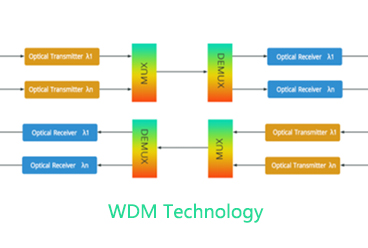
BiDi uses two wavelengths on one strand for a single point-to-point link. CWDM/DWDM multiplex many wavelengths onto one strand through external mux/demux units, scaling to 8, 18 or 40+ channels. BiDi is the simpler, cheaper option for one link; WDM is for many.
Sopto supplies both families from the same line: 10G SFP+ SR/LR/ER/ZR and 10G BIDI SFP+ at 10, 20, 40 and 80 km+, with A/B pairs shipped together, per-unit test data and EEPROM coding for Cisco, Huawei, H3C, Juniper and Arista.
Send us three details and we will quote the correct pair the first time: switch model, link distance, and fiber type.
WhatsApp: https://wa.me/+8613751094939
Email: [email protected]
Tags : 10G SFP+, 10G single fiber SFP+, BiDi SFP+, 10G SFP+ 10km/40km/80km, 10GBASE-BX
— END —